
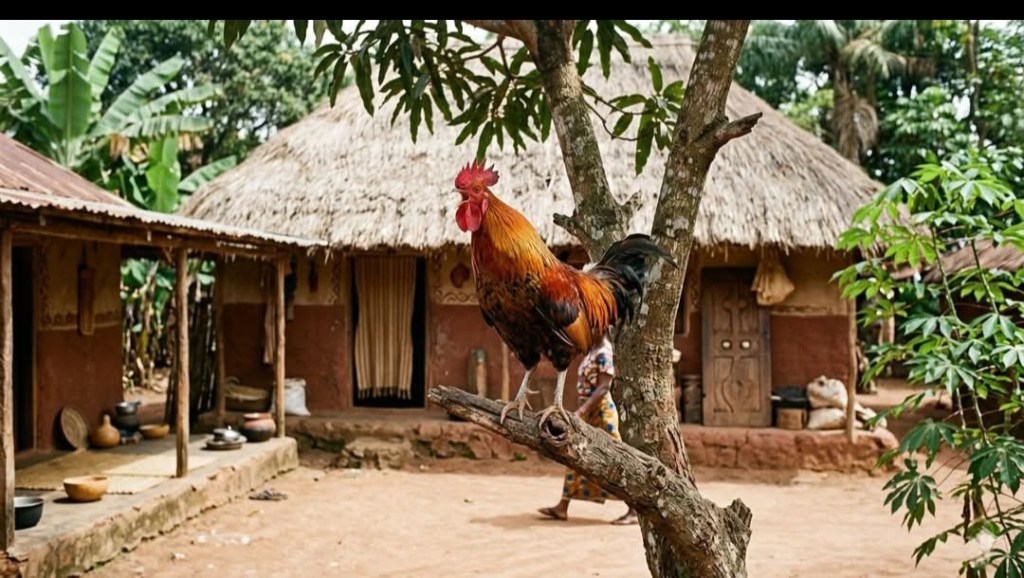
There was once a community of people who loved and cherished one another.
My people, there was a time when we all lived together—no big fences, no fear of one another. It was a period when hearing the voice of your neighbour ignited happiness; a time when men gathered together in their ebete, obi, or ogwe (village squares), as some villages call them, to discuss, gist, and reflect on the days of their youth.
Parents held meetings with their children, instilling family values and principles in them while also living those values out as examples. Folklores were told to children, and during these moments, parents learned more about their children’s thoughts and perceptions of life from the kinds of questions they asked and how they related to the stories.
From their engagement, you could identify the emotional child, the warrior, the diplomat, and, in some cases, the coward—often disguised as a wise one.
I recall one day when an elder was telling us a story about a tortoise and a lion—a story I had heard countless times. Personally, I cared less about the characters in the story; I was more focused on the moral of the story. However, one of my friends did not even allow the man to finish before stating that he did not believe the story had happened anywhere because no animal could talk.
The elderly man started laughing and jokingly called him eghu (goat). He then proceeded to teach him the art of listening to understand and the importance of questioning whatever he did not understand.
That became a character he carried with him even until today. He questions virtually everything and does not comment on something he is not sure about.
Nevertheless, the family remains the primary school of every child, where values, principles, morals, and the norms of society are learnt.
We built and lived in thatched houses. We grew up with folklores. Men wrestled, worked, and defended their territory. Women preserved and respected their bodies.
However, today, we have literally lost so much, and we are clearly angry with ourselves.
The family united its members in love. When siblings quarrelled or disagreed, they resolved their differences through umunna (elders), or simply through a higher authority. Uncles and aunties were not evil—at least not until Nollywood sold that idea to us.
I am not going to tell you that there were no bad or wicked people. However, my point is that there was a system in place to manage and handle these challenges.
Our ancestors believed in and lived by the spirit of oneness and togetherness, as often expressed in the saying: nwanne bu ike (siblings are your strengths).
The question we all need to ask is: What happened to our family system? Why have we forgotten who we are and chosen to be in perpetual warfare with ourselves and our brothers?
Today, in many families, children do not eat together anymore. Some parents only see each other at night because everyone is working hard to make ends meet.
Social media and influencers have replaced the roles of elders, parents, and guardians. Children are now sometimes seen as a means to an end, particularly in an age where content creation can pay off.
I sincerely believe that the civil war contributed greatly to this shift in our way of life.
Therefore, I am not advocating that we return to sitting in the village square to tell stories, although it would not be a bad thing. Rather, I am advocating that, regardless of where we find ourselves, we remember that we are a people known for morals and values.
Our ancestors were warriors, not cowards. They prioritised their families and children, and they had love for their neighbours.
So, instead of allowing the phone to separate you from your children, use it in a way that unites everyone. Structure your family in such a way that none of its members feels abandoned.
Many people have faced challenges in their academics and professions but are ashamed to go home. Many of our youths are dying in foreign countries because they are ashamed to start over again.
It should not be so.
Structure your family in such a way that everyone sees it as a safe place to return to when things become difficult.
In essence, what I am advocating for is the recognition that our way of life is not primitive. It was essentially crafted by our forefathers so that we may remain connected to our roots and to one another, regardless of where we find ourselves.
Remember, a lizard cannot assume itself to be a crocodile simply because it was born and lived inside an ocean.
Studying in a foreign land, having citizenship, or being born in a country other than yours does not make you an indigene of that country.
It is therefore important that, while you remain a good citizen of the country in which you find yourself (Maka na ebe onye bi ka o na awachi), you should always find your roots, live by their principles, protect your children, and preserve your family systems and values.
Additionally, value and love yourself. Be a person of good character so that the Lord will love you.
Finally, it is worthy to note that everything in existence today has always been there. We are only recycling.
People are going back to thatched houses. Folklores are now cartoons. Gwam gwam gwam and ukabuilo are what we call spoken words.
All this advancement should not make us lose our values and principles as human beings.
Enough is enough. Let us embrace peace and love for ourselves and our brothers, and protect ourselves from our enemies, as they will always be one.
Ukpana okpoko gburu nti chiri ya, ( the grasshopper that was killed by hornbill is simply deaf).
Be a person of value, principle, moral, and good behaviour, but guide it with wisdom.
I remain your friend and brother,
Maazi Onuora Obodoechi
Like, drop your thoughts, and share.
 Pen it down.