
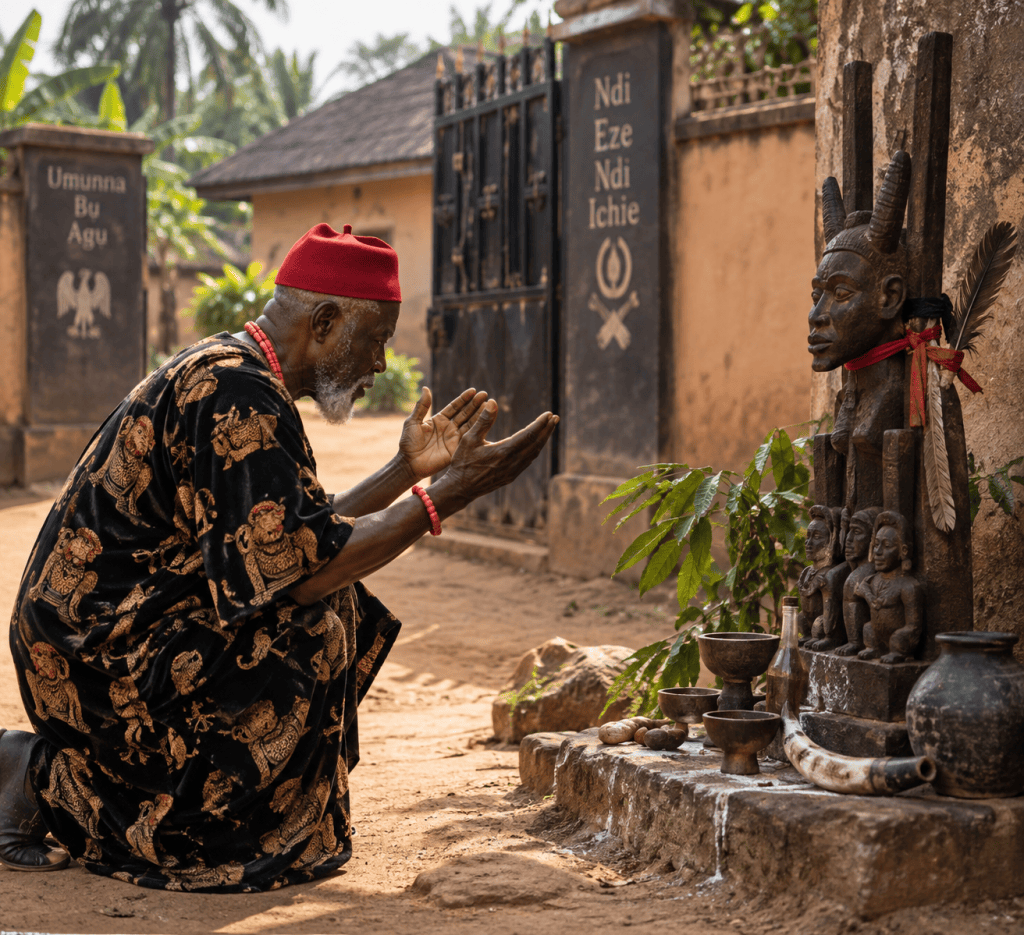
Maduka had just graduated from the University of Nigeria, Nsukka, with a First Class degree in Human Anatomy. Being the first child in his family, and the first person in his entire village to obtain a university degree, his achievement was more than just an accomplished milestone; it was a great honour to his father, Ichie Silas Obiekezie.
His father was seen dancing alongside family members, joyfully saying, “Ikenga m dị ile”—literally, “My God is faithful.” Everyone responded simultaneously, “Ọ dị ya oo!” (It is so!)
I know you might be wondering: In this modern age and time, how can someone still be talking about all these “fetish” things?
Now, let us actually reflect on what Ikenga means and represents.
There is a saying that when one’s personal god, or Ikenga, loses its potency, it inevitably becomes firewood.
We often view Ikenga simply as a deity, but the truth is that Ikenga can also be understood as a representation of one’s inner self and strength—strength that is built and reinforced by the record of successes achieved and trials overcome in the course of everyday life.
When viewed physically, Ikenga is a piece of carved wood with deep-rooted cultural meaning. Traditionally, it is believed to bring success and fortune to its custodian.
The word Ikenga is derived from ike (strength or power) and nga (pride, respect, or ego). When paraphrased, it can be understood as “the source of my power and pride.”
I know you may now be asking: What, then, is Ikenga, and why has it lost its popularity in today’s society?
Let me take you back a little.
In the olden days, before religious conquest and colonisation, many Igbo households had an Ikenga. Before a farmer went to his farm, he would remind himself, through his Ikenga, of what he hoped to accomplish that day.
The idea of Ikenga was to serve as a record of success and a reference point for what one had accomplished. In other words, Ikenga was not merely a deity; it was an idea created by our forefathers that allowed an individual to recognise and celebrate himself.
When the going became tough, a man would beckon on his Ikenga, reminding himself of the wars he had survived and the successes he had achieved in the past. In doing so, he found the strength to face whatever obstacles lay ahead.
A man drew inspiration from his Ikenga. He went to war with his Ikenga. He celebrated himself and boasted of his achievements through his Ikenga.
Hence, when a man became hopeless, it simply meant that he had lost touch with his accomplishments and, perhaps, with the reality of his own strength. At that point, he could see the carving only for what it physically was—a piece of painted firewood.
Our forefathers did not have the modern concepts of positive affirmation, motivational talks, or even a mirror in front of which to recite a litany of positive affirmations. But they had their Ikenga.
Ikenga was one’s inner self represented physically through a carving, allowing an individual to communicate with, recognise, and appreciate his own strength.
So, Ikenga did not vanish; it simply changed its name.
Today, we call it positive affirmation, self-belief, journaling, motivational talks, or personal development.
In a country and on a continent that is often quick to accept almost anything foreign while dismissing its own practices, it is not surprising that some of the ancient practices of our forefathers are gradually disappearing.
A continent that has, at times, been taught to view its ancestors as evil while embracing the traditions of those who enslaved and impoverished its people may understandably struggle to recognise the wisdom contained within its own heritage.
If you recall the story in the Bible where snakes were biting the Israelites, God instructed Moses to mould a serpent so that anyone who looked at it would be healed.
The moulded serpent was the accident, while what it represented—the promise of healing—was the substance of the action.
In the same way, the cross of Jesus Christ is the physical representation, while the promise of eternal life and the hope of resurrection represent the substance.
In the same manner, what our forefathers practised may not have been the idolatry we have sometimes been led to believe it was. It can also be understood as a classical and basic philosophy of introducing man to himself.
So, any day you affirm positivity or envision good health, you are, in a sense, speaking to your Ikenga.
Any time you recount how far you have come and the successes you have achieved, regardless of what name you give it, you are praising your Ikenga.
Educate yourself, my friends.
Read and reflect on the lives and wisdom of your ancestors, because he who does not know where the rain started beating him will lack the knowledge of when it stopped and how long it lasted.
It is high time we count our teeth with our tongues and learn to see things not merely by their physical representation but by the meaning and philosophy they contain.
Ultimately, everything you need to succeed begins within you. Seek knowledge to discover those strengths and apply them in your everyday life.
Do not give up on yourself.
Put God first and listen to that inner voice of wisdom. Feed your Ikenga with positivity so that you can continue to strengthen the person within you.
So, I ask you:
Ikenga gị, ọ dị ile?
Is your inner belief in yourself still strong?
I remain your friend and brother,
Maazi Onuora Obodoech
 Pen it down.