
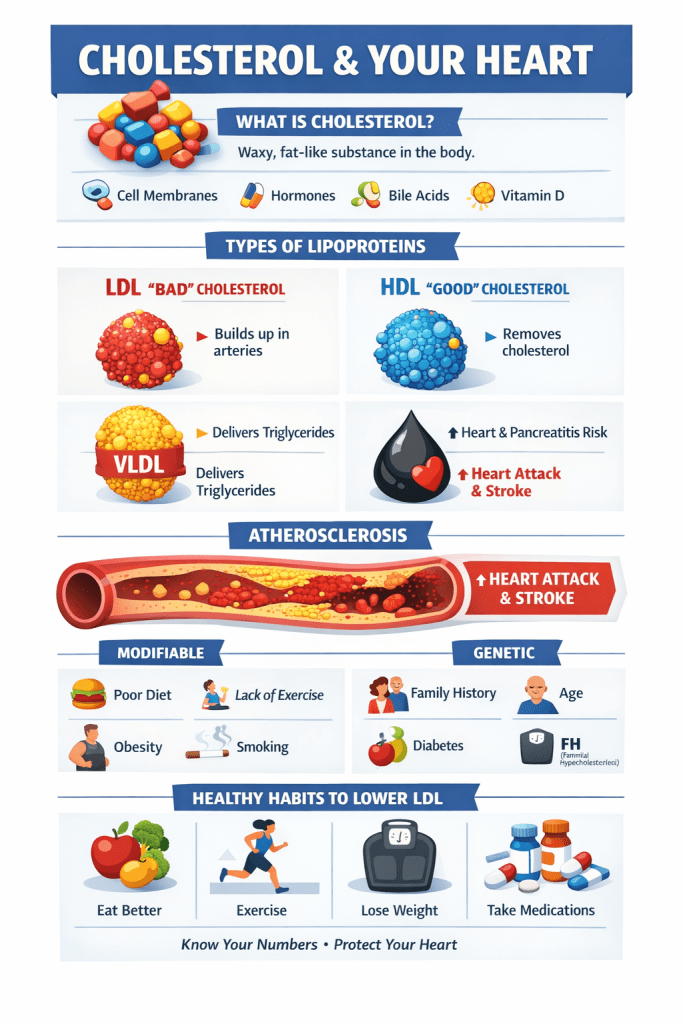
Cholesterol often gets labelled as “good” or “bad,” but the reality is far more nuanced—and far more important.
Understanding cholesterol isn’t just academic. It’s central to preventing heart attacks, strokes, and long-term cardiovascular disease.
🧬 What Is Cholesterol?
Cholesterol is a waxy, fat-like molecule (a sterol) that your body both:
- Produces in the liver (endogenous)
- Obtains from food (exogenous)
Despite its bad reputation, cholesterol is essential. It serves as:
- The structural backbone of every cell membrane
- A precursor to steroid hormones (cortisol, oestrogen, testosterone)
- A building block for bile acids (fat digestion)
- A precursor to vitamin D
Because cholesterol is hydrophobic (water-insoluble), it cannot travel freely in blood. Instead, it’s packaged into lipoproteins—specialised transport particles made of fats and proteins.
🚚 The Four Major Lipoproteins
Think of lipoproteins as delivery vehicles carrying cholesterol through the bloodstream.
🔴 LDL — Low-Density Lipoprotein (“Bad Cholesterol”)
- Transports cholesterol from the liver to tissues
- Excess levels lead to arterial plaque formation
- Causally linked to atherosclerosis
👉 The higher your LDL over time, the greater your cardiovascular risk.
🔵 HDL — High-Density Lipoprotein (“Good Cholesterol”)
- Removes excess cholesterol from tissues
- Returns it to the liver for disposal (reverse cholesterol transport)
⚠️ Important nuance:
While high HDL is associated with lower risk, raising HDL with drugs does not necessarily reduce heart disease.
🟡 VLDL — Very Low-Density Lipoprotein
- Produced by the liver
- Transports triglycerides to tissues
- Eventually becomes LDL in circulation
⚫ Triglycerides (TG)
- The body’s main fat storage molecule
- Elevated levels:
- Increase pancreatitis risk (>500 mg/dL)
- Signal metabolic dysfunction (e.g. insulin resistance)
📊 Cholesterol Levels: What’s Normal?
Cholesterol is measured using a lipid panel (fasting or non-fasting in most cases).
Key Reference Values (mg/dL)
| Measurement | Category | Value |
|---|---|---|
| Total Cholesterol | Desirable | < 200 |
| LDL | Optimal | < 100 |
| LDL | Very High | ≥ 190 |
| HDL | Low (risk) | < 40 (M), < 50 (F) |
| HDL | Protective | ≥ 60 |
| Triglycerides | Normal | < 150 |
| Triglycerides | Very High | ≥ 500 |
💡 Key Insight:
Treatment decisions are based on overall cardiovascular risk, not just cholesterol numbers.
- High-risk patients often target:
- LDL < 70 mg/dL
- Or even < 55 mg/dL in very high-risk cases
⚠️ How High LDL Damages Arteries
The link between cholesterol and heart disease lies in atherosclerosis—a slow, progressive disease of the arteries.
The Atherosclerosis Cascade
- Endothelial Dysfunction
Damage from hypertension, smoking, or diabetes allows LDL to enter artery walls. - LDL Oxidation
LDL becomes oxidised (ox-LDL), triggering inflammation. - Foam Cell Formation
Immune cells engulf ox-LDL → forming foam cells (early plaque). - Plaque Formation
Smooth muscle cells form a fibrous cap over a lipid core. - Plaque Rupture
The cap breaks → blood clot forms → heart attack or stroke
💡 Critical Insight:
Most heart attacks occur from unstable plaques that weren’t severely blocking the artery.
❤️🔥 Why It Matters: Cardiovascular Complications
Untreated high cholesterol contributes to:
- Coronary artery disease (CAD) → angina, heart attacks
- Ischaemic stroke → brain injury, disability
- Peripheral artery disease (PAD) → limb pain, amputation risk
- Heart failure → chronic heart damage
- Aortic stenosis → valve calcification
- Sudden cardiac death
⚖️ Risk Factors for High Cholesterol
🧩 Modifiable Factors
- Diet high in saturated/trans fats
- Physical inactivity
- Obesity (especially abdominal fat)
- Type 2 diabetes
- Hypothyroidism
- Excess alcohol
- Certain medications
🧬 Non-Modifiable Factors
- Familial hypercholesterolaemia (FH)
- Age (↑ risk after 45 men / 55 women)
- Male sex (pre-menopause)
- Family history of early heart disease
- Ethnicity (e.g. higher risk in South Asians)
⚠️ Special Case: Familial Hypercholesterolaemia (FH)
- A genetic disorder (~1 in 250 people)
- Causes extremely high LDL from birth (190–400 mg/dL)
- Leads to early heart disease
👉 Requires:
- Early diagnosis
- Aggressive treatment
- Family screening
🩺 How to Lower Cholesterol
Treatment depends on your overall cardiovascular risk, not just your LDL level.
🥗 1. Lifestyle Changes (First-Line for Everyone)
These can reduce LDL by 10–30%:
- Diet: Reduce saturated fats, increase fibre (oats, legumes)
- Exercise: 150 min/week → improves HDL & triglycerides
- Weight loss: Even 5–10% has major impact
- Stop smoking: Improves HDL and reduces risk rapidly
- Limit alcohol: Especially important for triglycerides
💊 2. Medications
Used when lifestyle changes aren’t enough or risk is high:
- Statins
↓ cholesterol production → lower LDL by 30–60%
👉 First-line therapy - Ezetimibe
↓ cholesterol absorption → additional ~15–20% reduction - PCSK9 inhibitors
↑ LDL receptor activity → reduce LDL by ~50–60%
👉 Used in high-risk or resistant cases
📈 3. Monitoring
- Regular lipid panels
- Adjust treatment based on risk + response
- Manage underlying conditions (diabetes, thyroid disease)
🧠 Key Takeaways
- Cholesterol is essential—but excess LDL is harmful
- LDL is a causal driver of atherosclerosis
- HDL is helpful, but not a treatment target
- Risk depends on lifetime exposure, not just a single value
- Lifestyle changes are powerful—and always required
- Medications (especially statins) save lives
- Genetic conditions like FH require early, aggressive treatment.
Health is wealth..
I remain your friend and brother,
Maazi Onuora Obodoechi

