
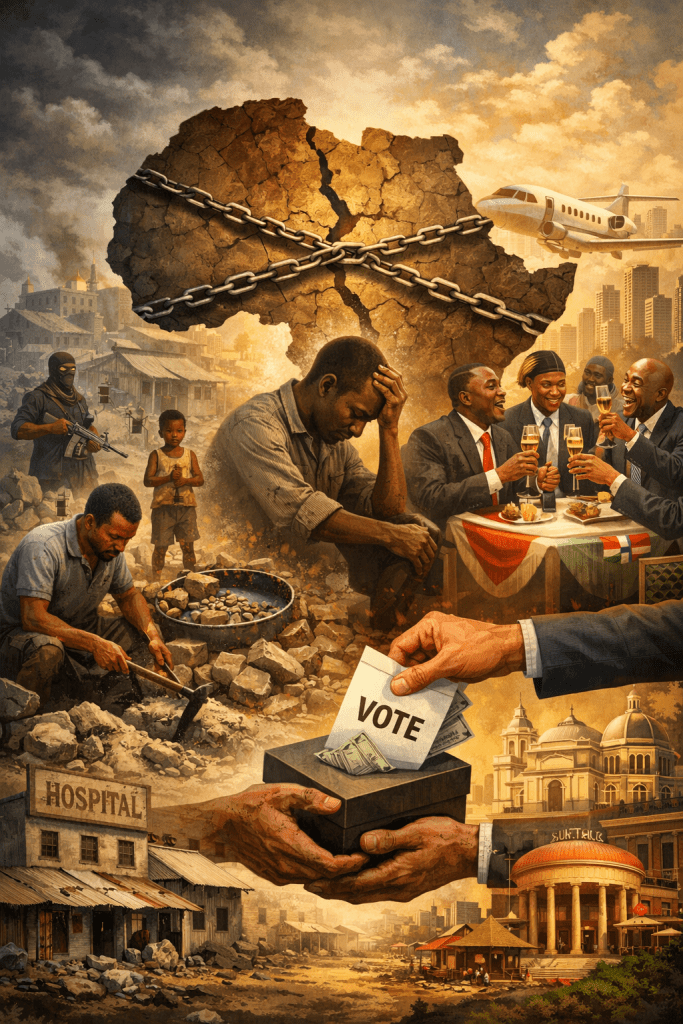
In the global arena where critical decisions are made, Africa is too often invited not as an equal stakeholder, but merely to be informed of how its wealth will be distributed among nations that have long prioritised the welfare of their own people. ❤️ This reality is both painful and deeply revealing.
Recently, I came across a news report of individuals mining solid minerals like tin and brass within their own compounds. Their justification was stark: they were left with a choice between armed robbery and what is termed “illegal” mining. ❤️ This speaks volumes about the level of desperation in our society and highlights a growing loss of faith in the government’s ability to provide for its citizens. At a time when insecurity and unemployment continue to plague the nation, it is disheartening to see leaders travel abroad in comfort, seemingly detached from the struggles of their people. ❤️
It saddens me to observe the level of sycophancy that exists not only within government circles but also among citizens. ❤️ I have previously written about this “table manners” phenomenon—the idea that people remain silent when benefiting from those in power, even when such power is abused. This culture of silence continues to erode accountability and integrity.
We are living in deeply troubling times. ❤️ If, hypothetically, a tyrannical leader were to emerge and attempt to revive something as inhumane as the slave trade, one must ask: would the kind of leadership we have today resist such a path? Or would they succumb without hesitation? These are uncomfortable questions, yet they demand reflection—especially when we react defensively to external criticisms without addressing internal failures. ❤️
There is a saying: he who describes his basket as a bin gives his neighbour the right to use it as a refuse container. ❤️ When we fail to value ourselves and our systems, we inadvertently invite exploitation. I do not place full blame on foreign powers who take advantage of this reality; rather, the greater responsibility lies with the leadership failures within our own continent.
We are gradually drifting toward a society where it is “every man for himself.” ❤️ The elites remain united, while the masses are divided. This division weakens us collectively and strengthens those who benefit from our disunity.
It pains me to admit that our poverty is not only physical but, in many cases, mental. ❤️ Some among us have been conditioned to see life only through the lens of survival, leading to decisions such as selling votes for temporary relief. This cycle perpetuates the very conditions we seek to escape.
True change will begin when we collectively prioritise the common good over personal gain in matters of nation-building. ❤️ Many already know the individuals capable of leading us toward progress, yet fear—the “what if”—pushes people to conform to systems they do not truly believe in.
As a continent and as a nation, we must move beyond being mere “talking drums.” ❤️ Let us begin by holding leaders accountable, irrespective of religion or ethnicity. Meritocracy—not emotional attachment or selfish interests—must guide our choices in leadership.
It is deeply concerning that while hospitals and schools remain inadequate, places of worship and entertainment centres continue to multiply. ❤️ Lives are lost daily, and this tragedy is becoming normalised. It has turned into a grim question of “who is next?” The sooner our politics shift toward ideology and genuine development, the better it will be for both the nation and the continent.
At all times, let us strive to be people of good character and do our part, no matter how small. ❤️ Change begins with each of us.
I remain your friend and brother,
Maazi Onuora Obodoechi ❤️

