
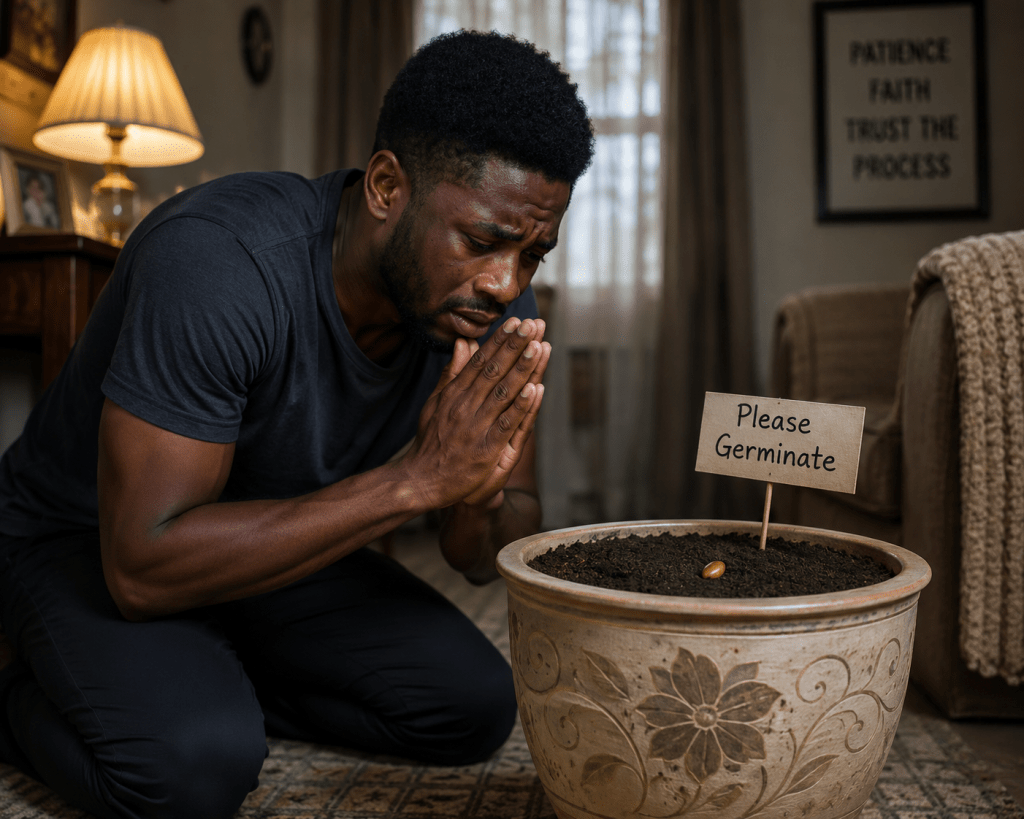
There is a story about a king who had three faithful successors. Tradition required that a king name his heir at a certain age to maintain order and prevent future family feuds.
This wise king, unsure of whom to choose, decided to test their character, wisdom, and loyalty. In those days, elders often spoke in riddles and created challenges to test the reasoning ability of their children.
He called the three young men and gave each of them a seed. He instructed them to plant and nurture the seed, saying that whoever’s seed germinated, grew, and bore fruit within two years would become his successor.
The three men happily took their seeds and planted them separately.
The seed was well known throughout the kingdom, and everyone knew it usually germinated quickly. However, after three months, none of the seeds had sprouted, and concern began to grow.
Two of the young men decided to obtain similar seeds from elsewhere. After all, they reasoned, if a tree grew, how would the king know whether it came from the original seed or not?
The third man, however, continued watering his seed faithfully, even though nothing appeared. Eventually, he told himself that perhaps it was not his destiny to become king. Since the other two men’s seeds had germinated and blossomed, he resolved to support whichever of them was chosen.
Little did he know that the others had secretly replaced the seeds the king had given them.
On the appointed day, the gong sounded: Kom! Kom! Ko! Ko! Kom! The people gathered, and the king welcomed everyone. It was time for the three men to present the results of their efforts.
The first arrived with a flourishing tree bearing fruit. The second did the same. The crowd applauded loudly. Young men and women celebrated the occasion with excitement and admiration.
Then the third man stepped forward—not with fruit, but with honesty.
He said, “My King, I am honored to have been considered for this position. However, my seed never germinated despite my efforts. I have come only to tell the truth.”
The king smiled and said, “My son, you are the chosen one.”
The crowd fell silent.
The king continued, “I gave each of you a boiled seed, knowing fully well that it could never germinate. These two men deceived me because they wanted to become king by any means necessary.”
Those who had cheered moments earlier suddenly became speechless.
Lessons and Reflections
How often do we rush through a process simply to enjoy people’s praise?
Many people choose leaders because they appear successful, even when their actions produce no meaningful results in the lives of those they lead.
We must understand that the process is just as important as the outcome—if not more important.
A results-only mindset is why a young girl with no job or skill may return home with an expensive phone, yet no one asks how she acquired it.
It is also why a young man with no legitimate source of income can buy expensive cars, stay in luxury hotels, and receive applause from society.
Today, we often celebrate material possessions without questioning the process through which they were acquired.
My point is simple: we must learn to value due process in every aspect of life—education, leadership, business, politics, and personal development.
It is time we stopped celebrating wealth that creates no value for others.
Be like Nkemakolam. Trust the process. Believe in yourself. Do not cheat.
Our people have a saying: “He who is in a hurry to harvest yam will still have to sit down and dig it out when it breaks apart in the soil.”
The lesson is clear: be patient with yourself. Celebrate success that comes through value creation, hard work, and integrity. In doing so, we encourage others to follow the same path.
I remain your friend and brother,
Maazi Onuora Obodoechi

