
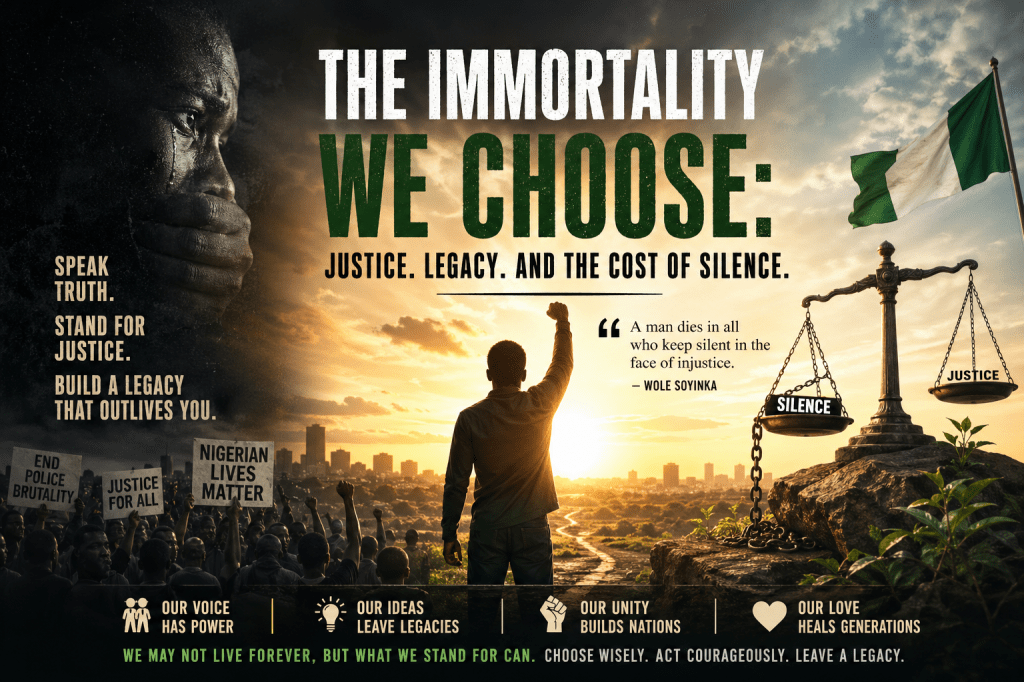
Life is often understood and viewed from perspectives that favor the observer. When you ask the grass in the field, the goat is the monster and the lion is the protector. However, I am very sure a goat will not see a lion as a protector, but as a predator. It was Wole Soyinka who said, “A man dies in all who keep silent in the face of injustice.”
There is one thing everyone must experience, and that is death. Death is inevitable; how and why you die is what matters. In Ernest Becker’s best-selling book, “Denial of Death” written while he was battling colon cancer, he explains how humanity’s attempt to preserve immortality has led to the creation of many civilizations.
He called it the “immortality project,” an attempt by the physical self to soothe the anxious mind about death by creating the idea of an immortal self. The need to still exist even after the physical body has died is what makes the idea of death less painful. He maintained that this is why people become parents, governors, warlords, and anything else that ensures they leave a legacy.
Some people left ideas behind and paid dearly for daring to achieve their own immortality project. People like Steven Biko, Thomas Sankara, Kwame Nkrumah, and the list goes on. All these men wanted not just to be remembered, but to liberate their people.
The sad reality of this immortality project is that while some channel their efforts into creating lasting value, others are bent on causing destabilization in the world. The goal is the same to be immortalized, however, the impact on the living varies greatly.
Additionally, when you ask someone in America, the UK, or China about police officers, you are likely to get a response associated with hope, protection, and justice. However, when you ask a Nigerian the same question, I believe you already know the answer.
On the 28th of April 2026, in Delta State, Nigeria, a police officer allegedly shot and killed an unarmed citizen who was willing to comply with an investigation. The painful part is that other officers and bystanders were present, yet no one could prevent the injustice. He was 28 years old, with ambitions and dreams, yet his life was cut short by the very force meant to protect him.
If such a barbaric act can happen in broad daylight, imagine what happens when no one is watching.
Many have suggested different solutions to the challenges faced by Nigerian youths. Some believe that leaving the country is the best option, but I doubt that Nigerians in South Africa would agree, given the hostility they sometimes face there.
The only solution that seems viable is to stay and confront this injustice. We cannot continue to run, because either way, lives are being lost. There is an urgent need for unity. From my observation, vast lands in Zamfara, Sokoto, Kwara, and other states rich in mineral resources such as gold seem to matter more to the elites than the people who live on them, people who are often unaware of the wealth beneath their feet.
However, a troubling question remains: why is the elites’ immortality project centered on eradicating their own people instead of preserving them? Why are Africans so willing to lose their sons and daughters instead of protecting them? Sadly, those who are brave and conscious are often avoided or even rejected by the very people they seek to defend.
Recently, in Mali, reports indicated that thousands of armed insurgents entered the capital in an attempt to destabilize a functioning government. One cannot help but ask: who is sponsoring them? Where did they come from? And why are other African nations not uniting to confront such threats?
There is so much happening, but my message remains the same: let us all get involved and develop genuine love for our country and continent. Since we are all going to die someday, let us commit to building a legacy that benefits our people.
There is enough space for everyone, if only we can let go of entitlement and the superiority mindset. The idea that all animals are equal, but some are more equal than others remains one of our greatest problems. Like the mushroom syndrome, growing bigger than others, only to be plucked too soon.
Our youths must understand that oppressors will not suddenly change and begin to care for you, unless you demand it and stand firm. It does not have to be violent, but it must be resolute: a decision to stand against injustice whenever it arises.
I will conclude with the words of Steven Biko: “It is better to die for an idea that will live forever than to live for an idea that will die.” Therefore, decide today what and how you want to be remembered.
Nigerian lives matter.
I remain your friend and brother,
Maazi Onuora Obodoechi.
 Pen it down.