
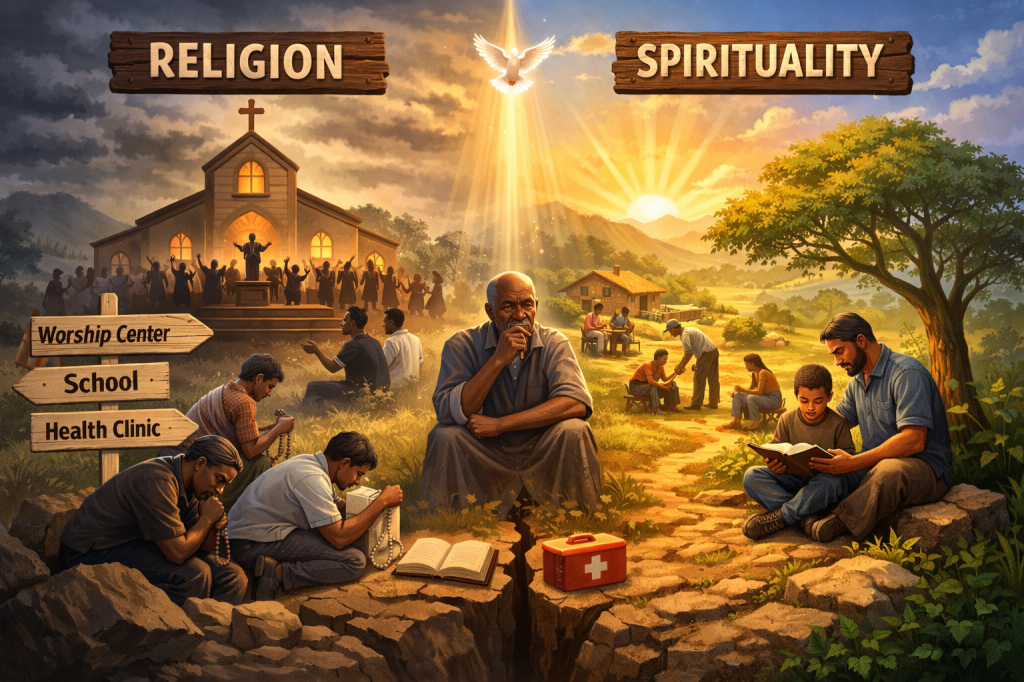
The elders in Umunomu village were once asked by the local government council to choose what their community needed most. They were given three options: a school, a health centre, or a worship centre. To the surprise of many, the majority of the community members chose the worship centre.
They prioritised building a place of worship over a school and a health centre. When a friend shared this story with me, I was not entirely surprised. Over time, it often appears that many of our people become so emotionally attached to religion that reasoning is sometimes set aside whenever worship is mentioned. ❤️
The truth is that many people do not clearly understand the difference between being religious and being spiritual. In simple terms, religiosity can sometimes resemble following the bandwagon, while spirituality points to a deeper, personal alignment with God. ❤️
Religion was originally intended to bring people closer to God. However, it can sometimes be used in ways that keep people overly dependent, obedient, and even naïve—especially when individuals stop thinking and growing for themselves. Jesus himself did not emphasise religious labels but demonstrated direct communion with God. In doing so, he showed that we also have the authority and the right to connect with God personally. That is why he said, “Where two or more are gathered in my name, I am in their midst.” The gathering, however, should be of people who are spiritually awakened, not merely people assembled around a personality. ❤️
Religion, in many cases, becomes a structured system of belief created and organised by people based on interpretations of the Gospel. Religious communities often have clear identities, doctrines, and rules that must be followed. It can involve submission to established authority, repetitive rituals, and practices centred on belief and faith. People are often taught that if they believe and follow every step correctly, they will achieve the desired outcome. And when things do not work out, they may feel they simply “missed a step.” ❤️
This approach sometimes shifts the entire responsibility onto the individual, making outcomes appear to depend solely on the strength of one’s faith. In many cases, religion becomes more focused on gathering followers than on deepening a genuine connection with God. It can also create boundaries between “us” and “them,” separating people based on belief systems. ❤️
What, then, about spirituality?
Spirituality goes beyond outward expressions of faith. It is about becoming the living expression of the Word of God. It does not end with speaking in tongues, quoting scriptures, or listening to sermons—it continues in actually living out what is preached. ❤️
True spirituality is about embodying values, morals, and principles that align a person with God and with their life’s purpose. It is about recognising the gifts and potential within you and working diligently to develop them. It does not seek to show off; instead, it quietly transforms you. Through your character and actions, you naturally become a teacher, a mentor, or a guide to others. ❤️
Spirituality reflects itself in everyday living—in discipline, in routine, in practical wisdom, and in placing God first in daily decisions. It is a lifelong journey that does not suppress reasoning but awakens the mind and consciousness to the will of God. ❤️
The house of God was meant to be a place where people filled with the Holy Spirit gather in sincerity—not a stage where deception or false miracles manipulate the vulnerable. ❤️
My point is this…
The kind of religion often practised in Nigeria sometimes appears to have clouded reasoning rather than strengthened it. Instead of drawing people closer to God, it can gradually pull them away from the deeper essence of faith. Rather than embodying the teachings of the prophets, people sometimes focus more on the messengers than on the message itself. ❤️
Many religious leaders struggle to speak truthfully about the realities affecting the people they lead. Meanwhile, many followers cling to the hope of heavenly rewards while neglecting the responsibility of developing their God-given potential here on earth. Some follow doctrines so strictly that they lose sight of their own purpose and growth. ❤️
My humble submission is this: it is good to follow the principles of God. If you are a Christian, pray and fast. If you belong to another faith, honour your path. But in all things, do not forget to discover, develop, and live out the potential that God has placed within you. ❤️
Let us not become like the people of Umunomu who chose to build a worship centre above the most basic needs of their community—though perhaps they were simply in a hurry to see God. ❤️
Always remember: be a doer of the Word, not a hearer alone. God is not mocked—what a person sows, that they will also reap.
So plant wisely. ❤️
I remain your friend and brother,
Maazi Onuora Obodoechi

